
GuardMyPhone
What happens after your phone leaves your hand?
A mobile security system built around the minutes that matter most — the ones between a device being taken and the owner getting control back.
- Digital security product
- System design · Engineering · Interface · Infrastructure
- Node.js · nginx · Ubuntu Server · PM2
- Deployed — guardmyphone.com ↗
Phone theft is not a hardware problem.
Replacing a handset is an expense. That is the part people quote. It is also the smallest part of what is actually lost.
A modern phone is the authentication device for everything else. It holds the mobile money, the message history, the saved sessions, the password resets, and the photographs. Whoever holds an unlocked phone briefly holds the person.
The window that decides the outcome is short, and it opens at the worst possible moment — when the owner is startled, without their device, and has no way to act.
A chain that runs without the owner.
The design constraint is that the person cannot be the trigger. If an action requires the owner to open an app, the system has already failed — they do not have the phone.
So the sequence has to start from the device’s own behaviour, and each stage has to be useful on its own in case the next one never happens.
Motion characteristic of a grab, distinct from ordinary handling.
Failed unlock attempts and access patterns that do not match the owner.
Evidence recorded at the moment of the event, before the device can be wiped.
Position established and tracked, so the evidence has a place attached to it.
The owner is notified through a channel that is not the stolen device.
Evidence and location assembled into something that can actually be acted on.
Built to survive the device being gone.
The device is assumed to be hostile territory the moment the chain triggers. It may be switched off, wiped, or put into aeroplane mode within seconds. Everything that matters therefore has to leave it early.
The service runs on a Node.js application behind nginx on Ubuntu Server, kept alive under PM2 process supervision, with TLS terminated at the proxy. Evidence and events are pushed off-device as they are produced, so the account remains useful even when the handset does not.
Detection thresholds, retention policy and notification channels are product decisions rather than implementation details, and are covered in a private technical write-up.
Designed for someone who is panicking.
The interface is used at the worst moment of a person’s week, often on a borrowed device. That rules out onboarding, dense dashboards and anything that needs to be learned.
What is left is a short set of decisions presented in order of consequence: where it is, what was captured, and what to do next.
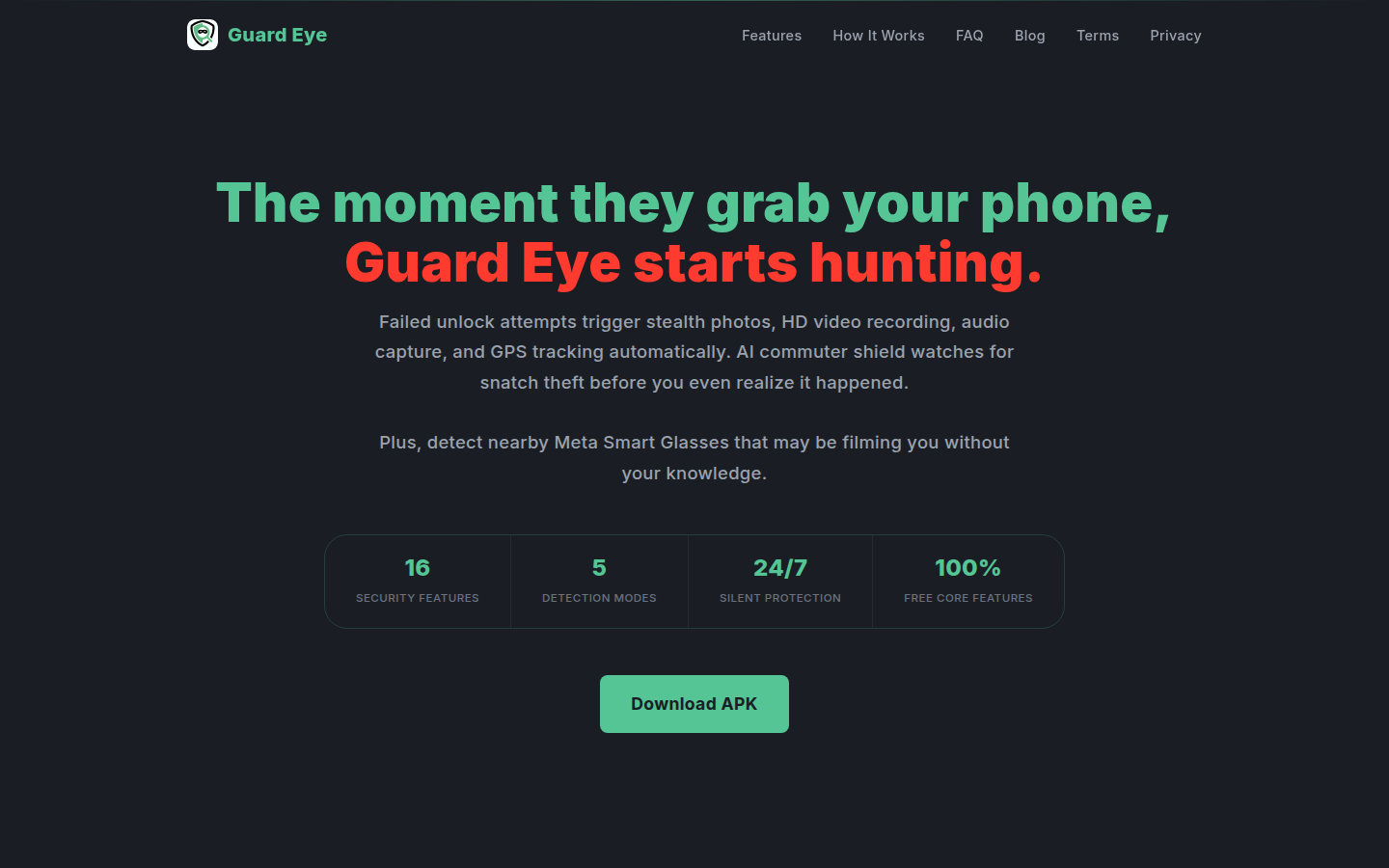
guardmyphone.com — captured 21 Sep 2026
What the system changes.
The product is live and running in production. What it changes structurally is the order of events: the response begins at the moment of the theft rather than at the moment the owner reaches a computer.
It also changes what a victim has. Instead of a description, they have a location trail and captured evidence tied to a timestamp — the difference between reporting a loss and pursuing a recovery.
Adoption & recovery metrics — to be published once measured