
Kidney Focus Kenya
Chronic illness is managed between appointments, not during them.
A monitoring platform that meets patients where they already are — in WhatsApp — turning home readings into something a clinician can actually act on.
- Health monitoring platform
- System design · Engineering · Conversational AI
- Python · Django · WhatsApp Business API · M-Pesa Daraja
- Live
The reading that matters is the one nobody records.
Hypertension and diabetes are managed by numbers taken at home, between appointments — blood pressure in the morning, glucose after meals. Those numbers decide whether treatment is working.
In practice they are written in a notebook, or not written at all. By the time a patient reaches a clinic, months of signal have been lost, and the consultation is based on a single reading taken in a waiting room.
The gap is not medical knowledge. It is the absence of a channel that patients will actually use every day.
WhatsApp is the interface, because it is the one people already have.
Rather than asking patients to install and remember an app, readings arrive as ordinary WhatsApp messages. The system parses them, decides how serious they are, and escalates only when escalation is warranted.
A patient sends a measurement in the chat they already use daily.
Parsed and read against that patient’s own history, not a generic threshold.
Triaged by how far outside range it is — routine, concerning, or emergency.
A personalised reply: reassurance, guidance, or an urgent instruction.
Emergencies are surfaced to clinicians rather than left in a chat log.
If a pattern goes quiet or drifts, the system reaches out with the question that fits.
Subscription and payment handled in-flow through M-Pesa.
A messaging system in healthcare needs a stop button.
The conversation is adaptive and history-aware — the reply to a reading depends on that patient’s recent trend, not just the number in front of it. Interactive buttons keep responses structured enough to parse reliably while still feeling like a conversation.
The decision I care most about is the global messaging kill switch: a single control that pauses all outbound patient messaging instantly. Any automated system that contacts patients needs one, because the failure mode of health messaging is not a bad user experience — it is a wrong message sent at scale to people who are unwell.
Onboarding explains why each question is asked and what the patient gets for answering. In health software, consent and comprehension are part of the interface, not a checkbox before it.
Two surfaces, one record.
A public site explaining the service, and a portal where patients see their own history and clinicians see the people who need attention today.
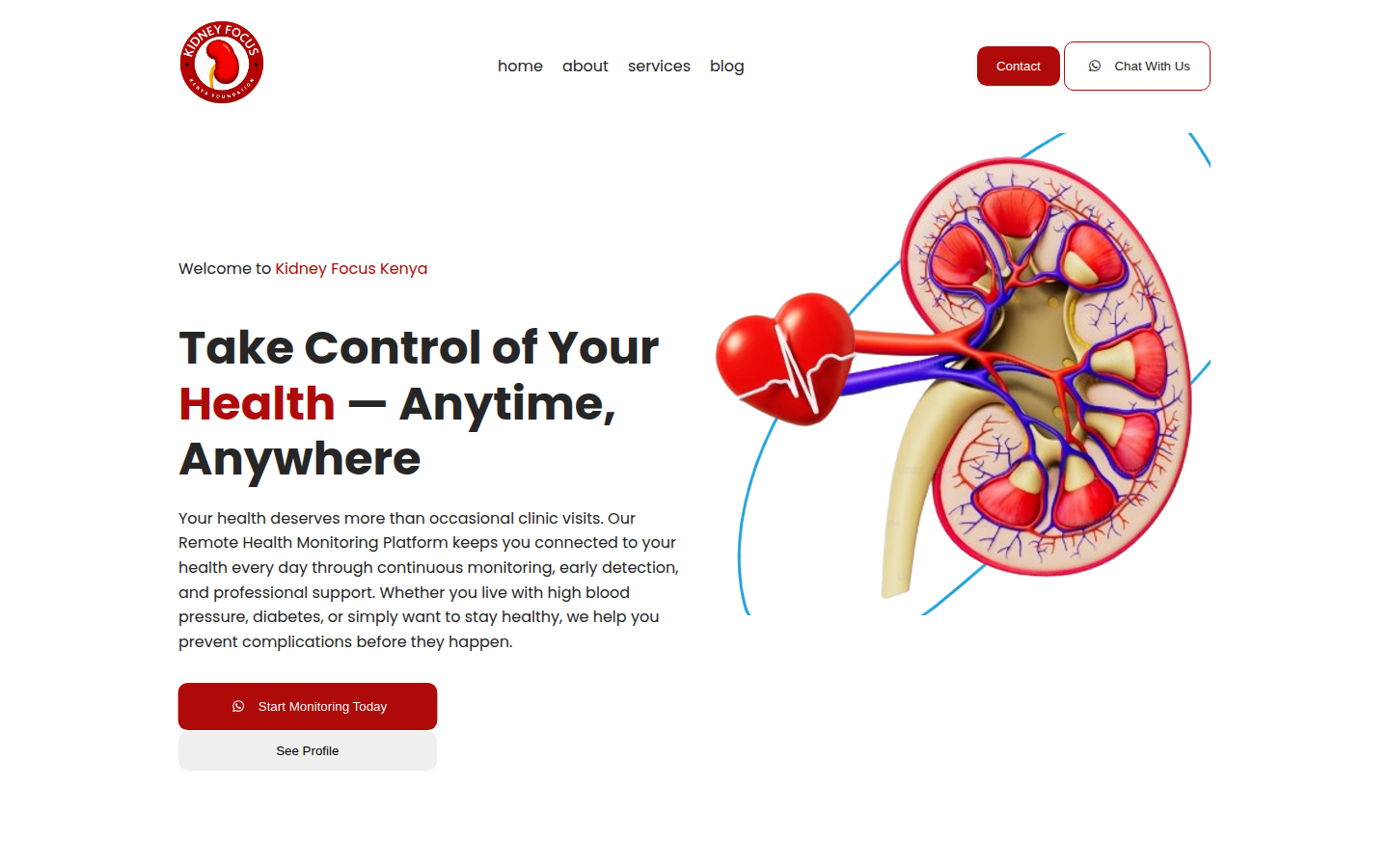
kidneyfocuskenya.org — public site. The patient and clinician portal sits behind authentication at app.kidneyfocuskenya.org.
What the system changes.
Readings taken at home stop evaporating. The clinician’s view shifts from a single measurement taken in a waiting room to a trend with history behind it, and deterioration becomes something that raises a flag rather than something discovered at the next appointment.
Patient and clinical outcome data — to be published with permission